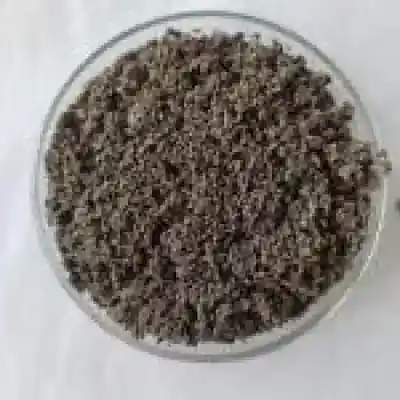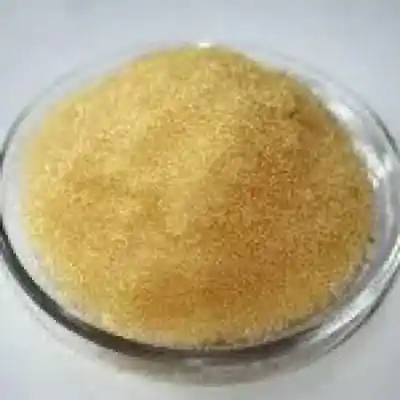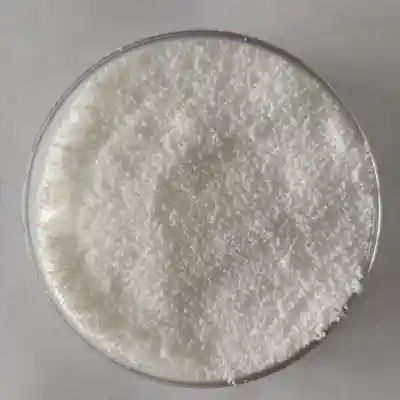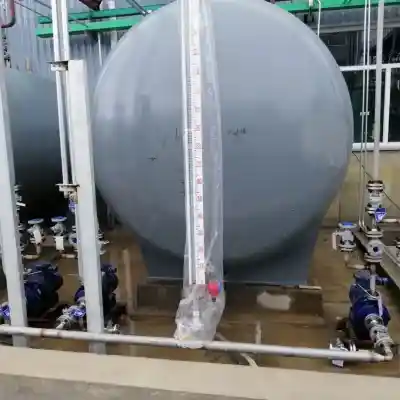

Total nitrogen is not a single pollutant but a family of nitrogen species. Ammonium nitrogen (NH₄⁺–N) and organic nitrogen — including amines, amides, amino compounds, and other nitrogen-bearing organics — exhibit different behavior, respond to different treatment mechanisms, and often coexist in the same stream.
For polishing, reuse applications, and challenging industrial matrices, polymeric ion exchange resins have become a dependable complement — provided the resin is matched to the nitrogen species it is expected to capture. That matching logic is the basis of the two-resin approach used in our nitrogen removal projects: HRC-18 for organic nitrogen and HRC-10 for ammonia nitrogen.
HRC-10: Engineered for Ammonium Removal
In water, ammonia exists in a pH-dependent equilibrium between dissolved ammonia gas and the ammonium ion. In the ionic form, ammonium is a cation — precisely what a strong-acid cation exchange resin is designed to capture.
The styrenic backbone and stable acid-form chemistry give HRC-10 the thermal and chemical robustness required for industrial service, making it well suited for:
Ammonia polishing after biological treatment.
High-strength or saline streams where biological treatment is unstable.
Water reuse and recycle loops requiring low residual nitrogen.
Intermittent or variable flows, where a physical process is easier to control than a biological one.
HRC-18: Targeting the Organic Nitrogen That Biology Misses
This is where many nitrogen projects quietly fail: after ammonium is removed or nitrified, the effluent is tested for total nitrogen — and organic nitrogen remains.
Built on an acrylic polymer architecture, HRC-18 combines cation exchange functionality with an adsorption-friendly matrix that interacts with organic nitrogen species through multiple mechanisms — ionic attraction where the molecule is charged, as well as hydrophobic and polar interactions with the polymer structure. The result is a resin capable of capturing nitrogen-bearing organic molecules that conventional ammonium resins fail to recognize.
Typical applications include:
Removal of amine- and amide-type organic nitrogen from chemical and pharmaceutical wastewater.
Polishing total nitrogen behind biological or physicochemical processes.
Protection of downstream reuse systems from organic fouling and nitrogen breakthrough.
Treatment of refractory streams where biodegradation alone cannot reach the limit.
Match the resin to the species, stage them correctly, and a nitrogen problem that looked like a plant-wide redesign becomes a well-defined treatment step.
If you are evaluating a nitrogen removal project — whether targeting ammonium, organic nitrogen, or total nitrogen in a difficult industrial stream — we are glad to review your water matrix and discuss the resin configuration that fits.
Disclaimer: Hairun Resin and its affiliates expressly disclaim all express or implied warranties (including, without limitation, warranties of timeliness, accuracy, completeness, reliability, or fitness for a particular purpose) with respect to the content of this document (including forward-looking statements). Neither Hairun Resin nor its affiliates shall be held liable for any consequences arising from errors, omissions, or other deficiencies in the document.