
Molybdenum is a critical refractory metal with irreplaceable roles across the global industrial supply chain — from high-strength alloy steels and stainless steels to fine chemical catalysts, electronic materials, and advanced coatings. Today’s molybdenum production is dominated by two major process routes, each with distinct characteristics yet facing a common challenge: significant molybdenum loss in process wastewater.
Case Study: Lab-Scale Validation — Resin Adsorption System
A leading Chinese molybdenum producer approached us to evaluate the feasibility of recovering molybdenum from their acidic roasting off-gas scrubbing wastewater. The raw wastewater was a deep blue solution at pH 3–4, containing approximately 18 g/L molybdenum along with dissolved iron, copper, calcium, magnesium, and sulfate ions. The objective was clear: design a resin-based separation system capable of selectively capturing molybdate ions from this complex acidic matrix, producing a concentrated eluate suitable for direct reuse in the production cycle, while reducing the molybdenum concentration in the treated effluent to near-zero levels.
Experimental Design
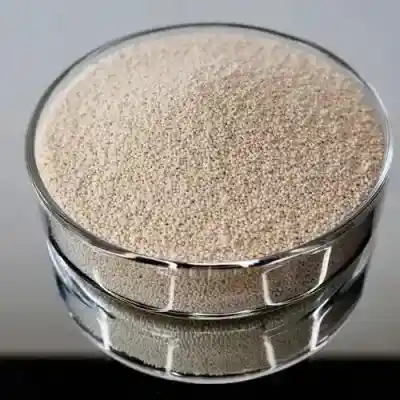
We conducted a systematic, multi-cycle bench-scale study using purpose-designed macroporous anion exchange resin in the chloride form. The core principle leverages the ion exchange reaction between molybdate anions (MoO₄²⁻) in the acidic feed solution and chloride ions (Cl⁻) pre-loaded on the resin functional groups. The experimental protocol was structured in four stages:
Stage 1 — Resin Screening. Multiple resin candidates were evaluated under identical acidic conditions to identify the optimal selectivity profile. The results were decisive: a conventional cation exchange resin (HO-1) proved non-selective, adsorbing molybdenum together with iron, copper, calcium, and magnesium — confirming that an anion exchange mechanism was essential for selective molybdate capture. The purpose-designed anion exchange resin (HA-300B) demonstrated superior selectivity for molybdate ions over competing anions.
Stage 2 — Single-Column Adsorption. A 50 mL resin bed was packed in a glass exchange column and operated at 1 BV/h flow rate. The raw feed (18.89 g/L Mo, pH 4) was passed through the column in sequential bed volumes (BV), with effluent samples collected and analyzed at each stage. Key observations emerged: molybdenum breakthrough was virtually undetectable through the first 12 BV, with effluent Mo concentrations remaining below detection limits. As adsorption progressed to 13–18 BV, the first column outlet gradually approached saturation at 18.05 g/L, while chloride ions released into the effluent dropped from 3.4 g/L to 0.88 g/L — evidence of progressive and near-complete ion exchange.
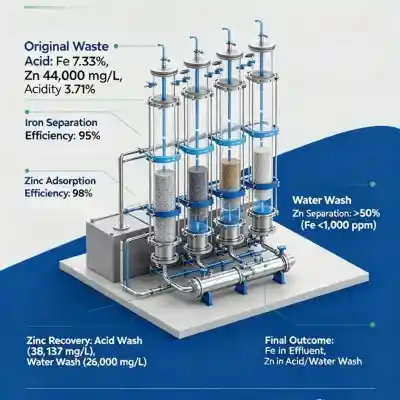
Stage 3 — Dual-Column Series Operation. To achieve continuous operation and maximize resin utilization, two columns were connected in series. The first column captured the bulk of the molybdenum load while the second column acted as a polishing guard, ensuring that effluent molybdenum remained at near-zero levels even as the first column approached saturation. This configuration extended the effective adsorption capacity to 32 BV per cycle — nearly triple the single-column breakthrough point — while maintaining effluent quality throughout the entire operating window.
Stage 4 — Desorption and Resin Regeneration. Saturated resin was eluted with 10% ammonia solution at 2 BV, converting the captured molybdate into a concentrated ammonium molybdate solution. A water displacement step followed, and the resin was regenerated with 4% hydrochloric acid to restore the chloride form for the next adsorption cycle.
Key Findings from the Lab-Scale Study
The bench-scale results validated the technical feasibility across multiple dimensions:
Selectivity confirmed. The anion exchange resin selectively adsorbed molybdate ions while leaving dissolved cations (Fe, Cu, Ca, Mg) in the effluent — a critical differentiator from conventional precipitation methods that co-precipitate all metal ions into mixed sludge.
Concentration factor achieved. The desorption process concentrated molybdenum from 18 g/L in the raw feed to an average of 135 g/L in the eluate — a 7× enrichment factor that makes the recovered molybdenum directly suitable for reintroduction into the production process.
Chloride control. Extended adsorption to 32 BV reduced chloride carryover in the eluate from 14 g/L (at 4 BV) to 2.4 g/L (at 32 BV), demonstrating that longer contact time enables more complete ion exchange and cleaner eluate.
Resin stability. Across five complete adsorption-desorption-regeneration cycles, the resin maintained consistent capacity and selectivity with no observable degradation, confirming long-term operational viability.
Production-Scale Implementation: Verified Performance Data
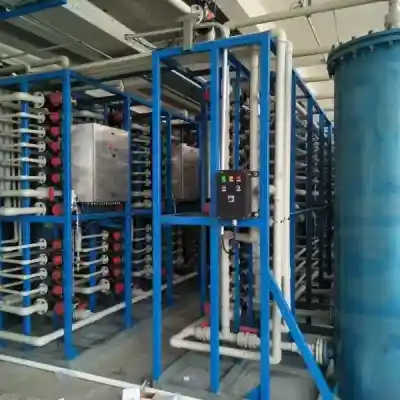
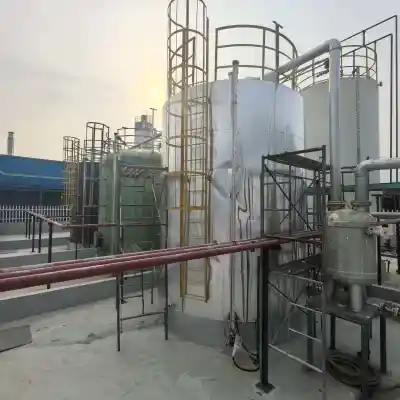
Following successful lab-scale validation, the system was engineered and deployed at full production scale. The following performance metrics were achieved in continuous operation:
| Performance Indicator | Value |
| Daily Processing Capacity | 100 tonnes/day |
| Feed Molybdenum Concentration | ~60 g/L |
| Effluent Molybdenum Concentration | < 5 g/L |
| System Configuration | Multi-Column Continuous Operation, continuous cyclic operation |
| Resin Utilization | > 90% of theoretical exchange capacity |
| Eluate Molybdenum Concentration | > 120 g/L (suitable for direct process recycle) |
| Operational Stability | Continuous operation with automated column switching |
The production-scale system operates on a fully automated cyclic schedule: while one column train is in adsorption mode, the parallel train undergoes desorption and regeneration, ensuring uninterrupted treatment of the process wastewater stream. The multi-Column Continuous Operation downtime and maintains consistent effluent quality across all operating phases.
Advantages of Resin Adsorption System
Economic Value. At current molybdenum market prices, recovering molybdenum from waste streams at the demonstrated concentration levels transforms what was once a disposal cost into a revenue stream. For a 100 t/d operation, the annual molybdenum recovery value runs into millions of dollars — paying back the system investment within the first year of operation.
Environmental Compliance. The resin-based system reduces molybdenum discharge concentrations by over 90%, enabling operators to meet increasingly stringent environmental discharge standards without generating secondary hazardous waste. Unlike chemical precipitation, no sludge disposal costs are incurred.
Process Integration. The concentrated ammonium molybdate eluate is chemically compatible with upstream hydrometallurgical processes, enabling closed-loop recycling and reducing fresh raw material consumption. For pyrometallurgical operations, the recovered molybdenum solution can be fed directly into roasting or calcination circuits.
Scalability. The modular column-based architecture scales linearly from bench to full production, with no fundamental change in process chemistry or resin performance. This makes it equally applicable to small specialty chemical producers and large integrated mining operations.
Our Capability
Hairun provide end-to-end solutions for molybdenum recovery and industrial wastewater treatment:
Resin Selection & Customization — Purpose-designed macroporous ion exchange resins tailored to specific feed matrices and recovery targets
Process Design & Engineering — From bench-scale feasibility studies through pilot testing to full-scale system engineering
System Integration & EPC — Complete turnkey delivery including column systems, piping, automation, and commissioning
Technical Support — Ongoing resin performance monitoring, optimization, and lifecycle management
Whether you operate a pyrometallurgical roasting facility or a hydrometallurgical purification plant, Hairun’s resin-based separation technology can help you recover valuable molybdenum from your waste streams while meeting the strictest environmental standards.
Disclaimer: Hairun Resin and its affiliates expressly disclaim all express or implied warranties (including, without limitation, warranties of timeliness, accuracy, completeness, reliability, or fitness for a particular purpose) with respect to the content of this document (including forward-looking statements). Neither Hairun Resin nor its affiliates shall be held liable for any consequences arising from errors, omissions, or other deficiencies in the document.