
Hydrogen peroxide is one of the most widely used oxidants in the world — in disinfectants and eco-friendly cleaners, food and packaging processing, pulp and textile bleaching, electronics, and fine chemicals. What many producers and formulators discover, however, is that concentration alone does not determine product value. Purity and stability do.
A 50% technical-grade H₂O₂ solution can still fail disinfectant-grade or food-grade specifications because of residual organics, phosphate, non-volatile residue, and — most critically — trace metal ions. Every part-per-million of iron or other transition metal acts as a decomposition catalyst, silently reducing shelf life, releasing gas in packaging, and creating safety and quality risks.
A cleaner and disinfectant manufacturer faced exactly this challenge. The answer was not another energy-intensive distillation column. It was a resin-based ion exchange and adsorption polishing line that upgrades technical-grade H₂O₂ directly, under mild conditions.
The Solution: Specialty Resin Polishing, Not Thermal Purification
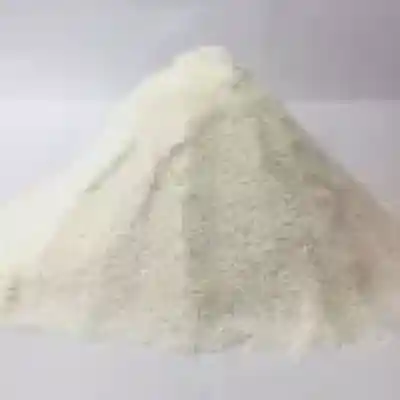
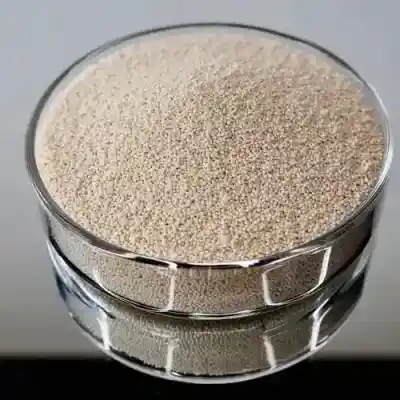
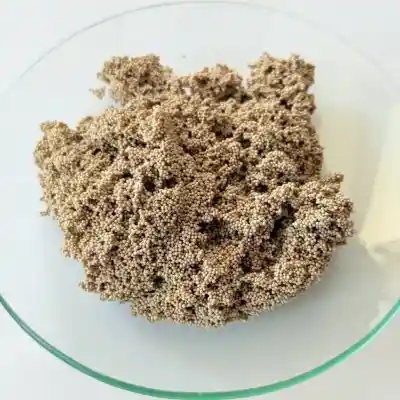
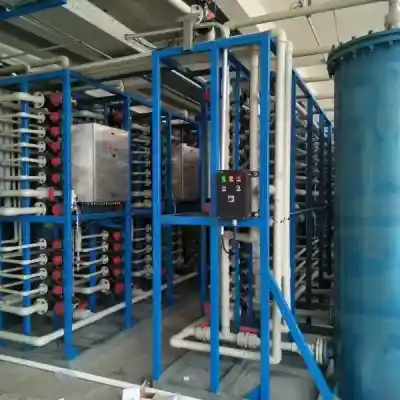
Hairun designed a polishing system around specialty ion exchange and adsorption resins selected specifically for compatibility with hydrogen peroxide service:
Adsorption resin captures residual dissolved organics (TOC) that survive conventional treatment.
Chelating / ion exchange resin binds trace metal ions that catalyze peroxide decomposition.
The media are oxidation-resistant, operate at ambient temperature, and require no steam, reboiler, or distillation energy.
Beds regenerate in place on a controlled cycle, and the skid runs under PLC automation with minimal operator input.
Importantly, the H₂O₂ itself passes through largely untouched — the target is the impurities, not the product. Peroxide loss across the polishing stage is minimal, which is exactly where resin-based purification beats thermal routes economically.
The Result:
After resin treatment, the finished 50% H₂O₂ meets the full specification for eco-friendly cleaner and disinfectant manufacturing:
✅ Stability ≥ 98.0% — up from 96.7%, meaning longer shelf life and safer storage
✅ TOC ≤ 40 mg/kg
✅ Phosphate ≤ 50 mg/kg
✅ Non-volatile residue ≤ 60 mg/kg, colorless liquid
✅ Trace metals controlled at grade
Why This Matters for H₂O₂ Producers and Formulators
1. Stability is money.
A product that decomposes faster loses assay value in storage, generates pressure in drums and IBCs, and limits how far you can ship. Moving stability from 96.7% to ≥98% directly extends saleable life and expands export reach.
2. One polishing line unlocks higher-value grades.
The same technical-grade feed can be upgraded toward disinfectant grade, food/packaging-grade, or electronics-use specifications by adjusting the resin sequence — without building new thermal capacity.
3. Lower operating cost than distillation.
No steam, no reboiler, minimal peroxide loss, and no large acid-resistant evaporator train. Regenerable beds and automated operation keep labor and consumable costs low.
4. Quality consistency batch after batch.
Resin polishing is a controlled, repeatable unit operation — critical when customers audit certificate of analysis (COA) values for TOC, metals, and stability on every delivery.
5. Safety by design.
Mild operating temperatures, no concentrated heat input to a strong oxidizer, and materials selected for H₂O₂ compatibility reduce the risk profile compared with thermal purification.
Where Resin-Based H₂O₂ Purification Applies
The same approach is relevant for any producer or user upgrading peroxide quality:
Disinfectant and eco-friendly cleaner manufacturing
Food and packaging-grade H₂O₂ (aseptic packaging, food-contact surface treatment)
Electronics and fine chemical applications requiring low-TOC, low-metal peroxide
Commercial H₂O₂ producers seeking to broaden their grade portfolio without distillation expansion
Bleaching operations (pulp, textile) where residue and stability matter
Disclaimer: Hairun Resin and its affiliates expressly disclaim all express or implied warranties (including, without limitation, warranties of timeliness, accuracy, completeness, reliability, or fitness for a particular purpose) with respect to the content of this document (including forward-looking statements). Neither Hairun Resin nor its affiliates shall be held liable for any consequences arising from errors, omissions, or other deficiencies in the document.